
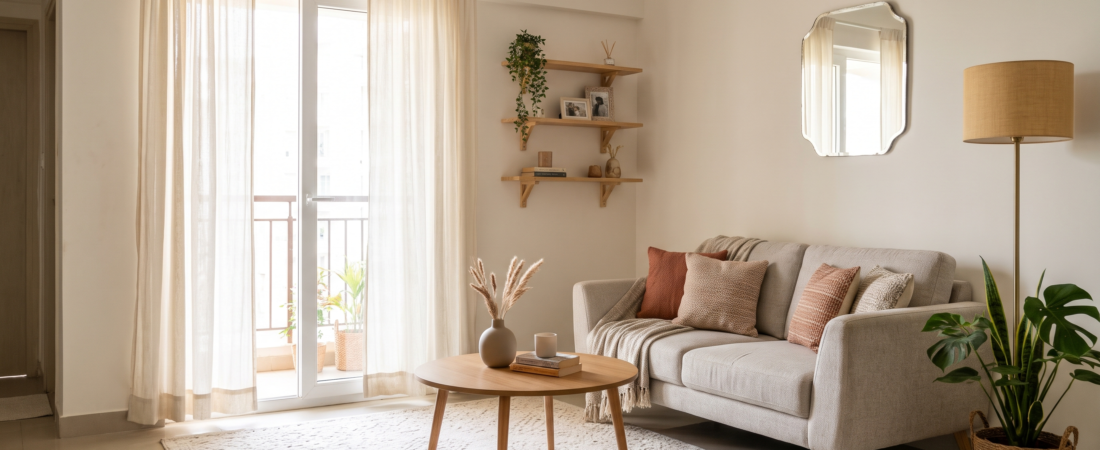
Designing a compact living room can feel like a constant balancing act between fitting enough seating and keeping the space from feeling cramped. Fortunately, making a room feel spacious has far more to do with visual flow, light reflection, and proportion than actual square footage.
By applying a few proven spatial design principles, you can open up sightlines, eliminate visual clutter, and make even a modest apartment living room feel airy and intentional.
1. Pull Furniture Slightly Away from the Walls
It seems counterintuitive, but pushing every sofa and chair flat against the walls actually emphasizes the tight boundaries of a small room.
- How to apply it: Leave even 3 to 5 inches of breathing room between the back of your main sofa and the wall behind it. Creating a subtle shadow gap tricks the eye into perceiving depth beyond the furniture, instantly making the room feel wider.
2. Choose “Leggy” Furniture Over Boxy Silhouettes
Heavy, skirted sofas and solid block coffee tables sit flush against the floor, blocking your line of sight and making a room feel weighed down.
- How to apply it: Opt for sofas, armchairs, and media consoles raised on slim wooden or metal legs. When you can see more of the floor stretching underneath your furniture, your brain registers the room as larger and less crowded.
3. Hang Curtains High and Wide
Standard curtain rods mounted right above the window frame visually cut the wall in half and make ceilings look lower than they are.
- How to apply it: Mount your curtain rod 4 to 6 inches below the ceiling (or as high above the window frame as possible) and extend the rod 6 to 10 inches wider than the window on both sides. When the curtains are open, the fabric frames the wall rather than blocking natural glass, drawing the eye upward and making the ceiling feel taller.
4. Use a Large Area Rug Instead of a Small One
A tiny rug floating in the center of the floor acts like a visual island, shrinking the perceived footprint of your seating area.
- How to apply it: Choose a rug large enough that at least the front legs of your sofa and accent chairs rest comfortably on top of it. A unified rug anchors the seating zone and creates the illusion of expansive floor space.
5. Place Mirrors Opposite Natural Light Sources
Mirrors are the oldest trick in interior design, but placement determines whether they open up a room or simply reflect clutter.
- How to apply it: Position a large mirror directly across from—or adjacent to—a window or balcony door. It will bounce natural daylight deeper into dark corners and create the visual effect of a second window. Avoid placing mirrors opposite messy entryways or tangled TV cables.
6. Stick to a Cohesive, Low-Contrast Color Palette
High-contrast color transitions (like dark walls paired with stark white furniture, or bold mismatched patterns everywhere) force the eye to stop and start repeatedly, making a small room feel busy.
- How to apply it: Keep your walls, large furniture pieces, and curtains within a harmonious tonal family—such as warm off-whites, soft beige, greige, or muted sage. Add personality through subtle variations in texture (linen, jute, matte ceramic, warm wood) rather than jarring color contrasts.
7. Layer Three Types of Lighting
Relying on a single bright ceiling light casts harsh shadows into the corners of a room, visually shrinking the walls inward.
- How to apply it: Combine three lighting layers at different heights:
- Ambient lighting: Soft overhead or cove lighting for general brightness.
- Task lighting: A floor lamp beside a reading corner or sofa.
- Accent lighting: Warm table lamps or wall sconces that wash dark corners in gentle light, pushing the visual boundaries of the room outward.
8. Swap Solid Coffee Tables for Glass or Round Shapes
Sharp rectangular corners disrupt foot traffic in narrow living rooms, while solid dark wood tables eat up visual space.
- How to apply it: Choose a round or oval coffee table to soften traffic flow around the sofa, or opt for a tempered glass or acrylic table that lets light pass straight through without visually interrupting the room.
9. Edit Surface Clutter Using the “Rule of Three”
In a compact room, twenty small knick-knacks scattered across shelves and tables create visual noise that makes the entire space feel tighter.
- How to apply it: Leave at least 30% of your shelf and tabletop space completely empty. Group decorative items in odd-numbered clusters of three—varying their height, shape, and texture—so each display looks intentional rather than crowded.
Putting It All Together
You do not need to overhaul your entire room at once to see a difference. Start with the zero-cost changes first: pull your sofa a few inches off the wall, clear excess items off your coffee table, and reposition a mirror or lamp toward a dark corner. Small shifts in proportion and light are often all it takes to transform how spacious your living room feels.